The 1950 U.S. Open
In the run-up to the US Open at Shinnecock Hills, I'm posting excerpts from 'The Story of Golf in 50 Tournaments' that cover the Championship. Today, Ben Hogan's incredible victory at Merion in 1950.

Hogan wins second U.S. Open and fourth major title 16 months after horrific crash.
Venue: Merion GC (East Course), Ardmore, Pa.
Dates: June 8-11
Winner’s prize: $4,000
In the field: Ben Hogan, Sam Snead, Jimmy Demaret, Julius Boros, Cary Middlecoff
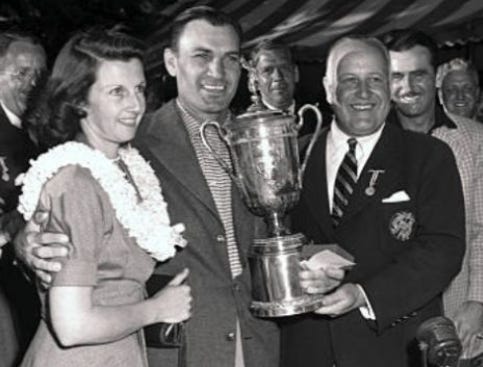
In 1948, Ben Hogan won 10 tournaments including the U.S. Open at Riviera CC in California and the PGA Championship at Norwood Hills CC in Missouri. One month into 1949, he’d already added two more titles to his growing collection, winning the Bing Crosby Pro-Am at Pebble Beach and the Long Beach Open at Lakewood CC in suburban Los Angeles. The odds were pretty good then the 36-year-old Texan was going to have another stellar year, add to his major count, and cement his position as the best player in the world.
On the morning of February 2 (the day after he had lost to Jimmy Demaret in a play-off for the Phoenix Open), however, the man referred to as the “Little Mr. Boom of Golf” was involved in a horrific car crash which put him out for the rest of the season.
Driving home from Arizona with his wife, Valerie, Hogan was carefully cruising along a somewhat icy stretch of Highway 80 outside Van Horn, Texas, when a Greyhound bus, traveling in the opposite direction, pulled out into the eastbound lane and plowed head-on into Hogan’s black sedan. Alvin Logan, the driver of the bus, had attempted to overtake a truck at 50mph – a reckless maneuver given how foggy it was. In an attempt to avoid the bus, Hogan turned his steering wheel as hard to the right as he could, but it was too late. He instinctively flung himself across Valerie, who fortunately escaped the wreckage with minor cuts and bruises. And although Hogan himself suffered a broken collarbone, broken left ankle, contusions to his left leg, a cracked rib, a double fracture of his pelvis, and a head abrasion, by saving Valerie he had almost certainly saved himself, too, as the car’s steering column was shunted clean through the driver’s seat.
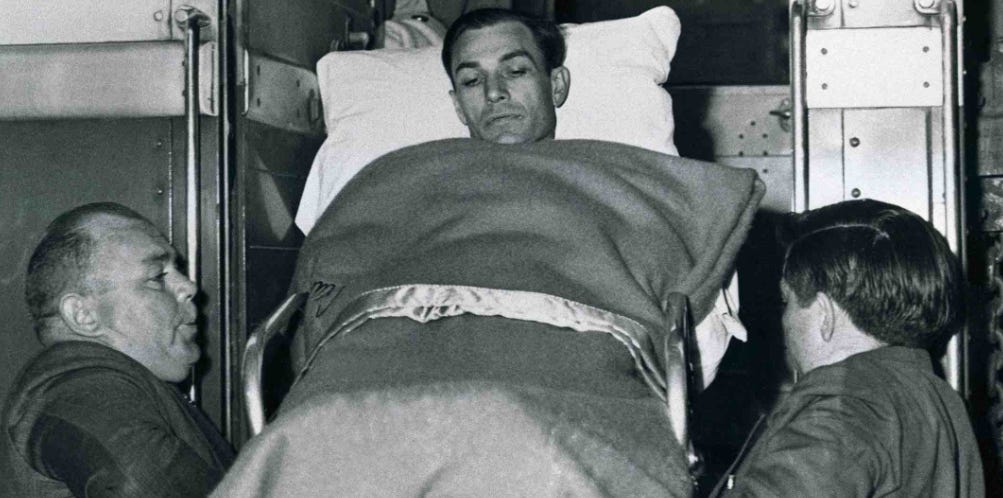
Hogan spent 59 days in the hospital at El Paso, and —at one point —phlebitis caused blood clots in his leg and one in his lung, which required specialist attention from a New Orleans vascular surgeon named Dr. Alton Ochsner.
As his fellow competitors had learned by now, Hogan was a grimly determined individual, and even though his doctors said there was a chance he might never walk again, let alone play golf, Hogan showed up at the Texas PGA Championship in May—three months after the crash and a few weeks after returning home—to watch Byron Nelson and other friends compete, and speak to reporters. In March, Hogan had vowed to come back to the game despite his injuries during an interview with the Fort Worth Star-Telegram. “You work for perfection all your life, and then something like this happens,” he said. “But you can bet I’ll be back there swinging.”
By September, he had improved sufficiently to travel to England and captain the U.S. Ryder Cup team. And he played his first 18 holes since the accident in December - a round at Colonial CC with the head professional, after which Hogan said he hadn’t hit the ball terribly well. Ninety-nine per cent of golfers would surely have been pleased with Hogan’s level of ballstriking, but - even with fragile, painful legs - he held himself to uncommonly high standards.
Amazingly, Hogan was back competing in top-class events just a month later, returning to Riviera CC where he had won the 1947 and 1948 Los Angeles Opens and ‘48 U.S. Open, and which was now being referred to as ‘Hogan’s Alley’. During a first-round 73, he asked photographers not to take pictures, saying “No pictures or no play”—a stipulation to which the photographers reluctantly agreed.
Even more unlikely than being able to play in the first place was the fact Hogan held the clubhouse lead after 72 holes—completing them on 4-under, 280. He would have won the event on Sunday evening had Sam Snead not birdied the final two holes to tie him, the final birdie coming after holing a 12-foot putt that was delayed a moment after a spectator fell out of a tree.
Though few people were expecting much from Hogan that week, Snead knew better. “A lot of people didn’t think he would be able to play very well,” Snead said later, “but I knew he would. Knowing Ben the way I did, I knew he would never be unprepared to play in a tournament. If he said he was ready to play, I knew he was ready to play great.”
Due to heavy rain, the playoff would have to wait a week, as the players had to move on to the Bing Crosby Pro-Am at Pebble Beach, which Snead won. Back at Riviera for the 18-hole playoff, Snead won again, beating Hogan 72 to 76. Snead might have claimed the trophy and $2,600 winner’s check, but Hogan won the admiration of the gallery who learned never to underestimate him. Sportswriter Grantland Rice summed it up nicely, saying “His legs weren’t strong enough to carry his heart around.”
At the Masters in April, Hogan finished tied for 4th, completing the 72 holes on level-par 288 - five shots behind Jimmy Demaret who won his third Green Jacket. And though there was some doubt as to whether Hogan would be able to complete four rounds at a 6,694-yard U.S. Open venue with 36 holes on the Saturday, Snead knew what to expect at Merion in June. “Hogan is the man who might make some trouble,” he said. “He’s the man I’ve got to beat.”
After a first-round 72, Hogan led Snead by a shot, but was eight strokes behind the leader—Lee Mackey, an unknown 26-year-old from Birmingham, Alabama, described as a “medium-sized chap with a crew haircut and sun-burned face.” Mackey was a late entrant, having qualified with scores of 75 and 74, and his 64 at Merion broke the U.S. Open’s single- round record and gave him a three-shot lead.
The surprise early leader bombed out with an 81 the following day, while Hogan, who had removed the 7-iron from his bag for the tournament saying the course had no 7-iron shots, climbed from T18 to 5th with a fine 1-under 69 that put him just two behind the new leader, Dutch Harrison. Hogan then led after 11 holes of round three, but a disappointing finish saw him fall back into a tie for 3rd, a shot behind Harrison and two behind 54-hole leader, Lloyd Mangrum.
In the final round on Saturday afternoon, Mangrum struggled to the turn in 41 but settled down on the back nine, shooting a 76 for a four-round total of 7-over-par. George Fazio, who had started the round in a tie for 8th, shot a closing level-par 70, joining Mangrum on 287. And Hogan, with a two-shot lead with four holes to go, bogeyed the 15th and 17th so needed to par the tough 458-yard closing hole to make it a three-way tie at the top.
After a perfect drive, Hogan was left with about 215 yards uphill and into a slight headwind. He hit a beautiful 1-iron (well … see below) to the front-left of the green, leaving a 40-footer for birdie and the win. His first putt was long and left, and the four-foot knee-knocker he’d left himself crept in the right edge of the hole for a tying par.
1 or 2?
A debate over whether Hogan hit a 1-iron or a 2-iron to the 18th green in the final round has continued for decades, with many credible voices on either side. In his seminal instruction book Five Lessons: The Modern Fundamentals of Golf (published in 1957, and co-written with Herbert Warren Wind with illustrations by Anthony Ravielli), Hogan stated it was a 2-iron, but he later admitted that was a mistake.
The club Hogan is said to have hit is now displayed in the USGA Museum, though some uncertainty surrounds it as well: - the club was stolen from Hogan’s bag sometime during or immediately after the U.S. Open and wasn’t discovered for 30+ years. A club-collector from North Carolina purchased a Hogan 1-iron in 1983, and because of the wear-pattern on its face, suspected it was the club. He sent it to the Hogan club company, where Hogan confirmed it was indeed the club he had used to hit his famous approach to Merion’s 18th. Hogan then sent it to the USGA.
A handful of Hogan devotees and noted golf historians have undertaken extensive research to prove one way or the other and, to anyone with even a modicum of interest in the subject, it all makes compelling reading. On the surface, it seems strange that someone as meticulous, obsessive, and detail-oriented as Hogan could possibly have made a mistake over which club he used. But his last word on the subject before he died in July 1997 was that it was a 1-iron.
Peskin’s Picture
The beautifully struck shot Hogan hit at the 18th in the fourth round that helped him get into the playoff was bettered for timing only by photographer Hy Peskin’s shutter finger which he deployed at the perfect moment to capture one of golf’s (all of sports’?) greatest ever photographs.
An intense, abrasive character, and something of a loner who did whatever was necessary to get the shot he wanted, Peskin reportedly hadn’t taken a single shot before the 18th hole. And while every other photographer went ahead of Hogan to get the shot of his face after impact, Peskin remained behind him, looking down the shot line with the green and rough ringed by spectators ten-deep in places. The enormous American flag swaying in the background is a nice addition.
The photograph Peskin took is so good because it captures a history-making shot. The fact so many spectators are there, finding whatever space they could, suggests this is a moment of great significance. And there - front and center, all by himself - is a perfectly-balanced Hogan at the end of what we know was another flawless swing. Had Hogan gone on to three-putt or lose in the following day’s playoff, the image wouldn’t have become nearly so famous. As it is, it’s the perfect portrait of a great golfer’s temperament, confidence, poise, and skill.
Hogan, Mangrum, and Fazio would reconvene on Sunday for an 18-hole playoff, with Hogan leading by one as they played the 16th hole. On the green, Mangrum marked so Fazio could finish. After replacing his ball, a bug landed on it, so Mangrum picked it up, blew the bug away, and replaced it. But he shouldn’t have. In most professional events in 1950, players were permitted to mark their ball anywhere on the green, but in USGA strokeplay events such as the U.S. Open, players were only allowed to mark their ball if it interfered with another player’s line. By picking his ball up and replacing it after Fazio had already putted out, Mangrum incurred a two-stroke penalty, putting Hogan three clear. It became a four-shot lead after Hogan made a 50- foot birdie putt on the next, and 20 minutes later, he claimed his second U.S. Open title, with a 1-under 69, beating Mangrum by four and Fazio by six (he would successfully defend the title the following year at Oakland Hills, and win again in 1953 at Oakmont).
Given what had happened to him just 16 months prior, the pain he played with, and the stress of five U.S. Open rounds against top-level competition, what Hogan accomplished at Merion in 1950 is truly remarkable. Plenty of other athletes have suffered injuries and later returned to professional sport, but it’s unlikely any of them climbed so high and steep a mountain as Hogan.
It’s a magnificent story, and you’ve done it justice, Tony! I’d never realised quite the scale of the accident, nor just how fast Hogan’s return to the winner’s circle was. Loved this in your latest book, and great to see it here!